Monday, September 12, 2016
LONGSHOREMEN READY IN PHILLY
Letters: Longshoremen geared up for a busier Philly port
http://www.philly.com/philly/opinion/20160907_Letters__Longshoremen_geared_up_for_a_busier_Philly_port.html


LONGSHOREMAN Killed In Georgia
Longshoremen killed in accident at Georgia port
http://www.bizjournals.com/atlanta/news/2016/09/08/longshoremen-killed-in-accident-at-georgia-port.html
Tuesday, August 30, 2016
VANCOUVET LONGSHOREMAN ADMITS COCAINE SMUGGLING
REAL SCOOP: Vancouver longshoreman admits role in drug ring
http://vancouversun.com/news/staff-blogs/real-scoop-vancouver-longshoreman-admits-role-in-drug-ring
Monday, August 29, 2016
RESCUE VESSEL ATTACKED
http://www.marineinsight.com/shipping-news/rescue-vessel-bourbon-argos-attacked-armed-men/?utm_content=buffer8e976&utm_medium=social&utm_source=twitter.com&utm_campaign=buffer
Saturday, August 27, 2016
Your Port of Olympia Over Labor Day Weekend
Wanna tour the Port of Olympia marine terminal? Here's your chance
http://www.theolympian.com/news/business/article97949422.html
Thursday, August 25, 2016
Maritime worker blames vessel owner for injuries
Maritime worker blames vessel owner for injuries: NEW ORLEANS — A Mississippi man is suing a Baton Rouge shipbuilding company, alleging its negligence led to the plaintiff suffering injuries.
Friday, August 19, 2016
Wednesday, August 17, 2016
Saturday, August 13, 2016
Diver alleges pipeline operator caused his injuries in ship fire
Diver alleges pipeline operator caused his injuries in ship fire: NEW ORLEANS — A commercial diver is suing a support vessel and pipeline operators, alleging their negligence caused injuries to the plaintiff.
Longshoreman alleges he was injured while working for Boh Bros. Construction
Longshoreman alleges he was injured while working for Boh Bros. Construction: NEW ORLEANS – A couple seeks damages after the husband was allegedly injured while working as a longshoreman.
Tuesday, November 3, 2015
ILWU OFFICE CLERKS, EMPLOYERS TO BEGIN 2016 TALKS THREE MONTHS EARLY
ILWU OFFICE CLERKS, EMPLOYERS TO BEGIN 2016 TALKS THREE MONTHS EARLY

Hoping to avoid tumultuous negotiation like in 2010 and with shippers’ patience already low, International Longshore and Warehouse Union office clerical workers in Los Angeles-Long Beach are expected to begin negotiations with employers in April — less than three months before the current contract expires.
Shippers are in no mood to tolerate more work stoppages next year involving ILWU office clerical workers, said attorney Stephen Berry, who represents the 15 marine terminals and shipping lines. After enduring months of West Coast port congestion and work slowdowns associated with the coastwide ILWU dockworker negotiations with the Pacific Maritime Association, shippers are keeping some of the cargo they diverted to East and Gulf Coast ports.
The Office Clerical Unit of ILWU Local 63 represents about 600 office workers who process shipping documents at 15 marine terminals and shipping lines in Los Angeles-Long Beach. Negotiators for the employers and the OCU must agree upon 15 separate contracts, an exercise which in its own right is a Herculean task, and cries out for early negotiations.
In fact, Berry said he recently discussed with OCU President John Fageaux the possibility of launching early negotiations this year, but Fageaux indicated he prefers to stick with the normal bargaining timeline of beginning negotiations in the spring, allowing less than three months to reach an agreement before the current contract expires on June 30.
“Employers are keenly aware of the diversion of cargo that took place to the East Coast, and the impact of the diversion on job opportunities at West Coast ports,” Berry said in reference to the crippling port congestion earlier this year during the ILWU dockworker negotiations. “We want early resolution of these 15 contracts. We don’t want prolonged bargaining,” he said. Fageaux was not immediately available for comment.
....CLICK LINK FOR FULL ARTICLE at Journal of Commerce
ILWU MEMBER LEADS EFFORT TO HELP OTHERS LEFT BEHIND ON HARBOR AREA STREETS
ILWU MEMBER LEADS EFFORT TO HELP OTHERS LEFT BEHIND ON HARBOR AREA STREETS
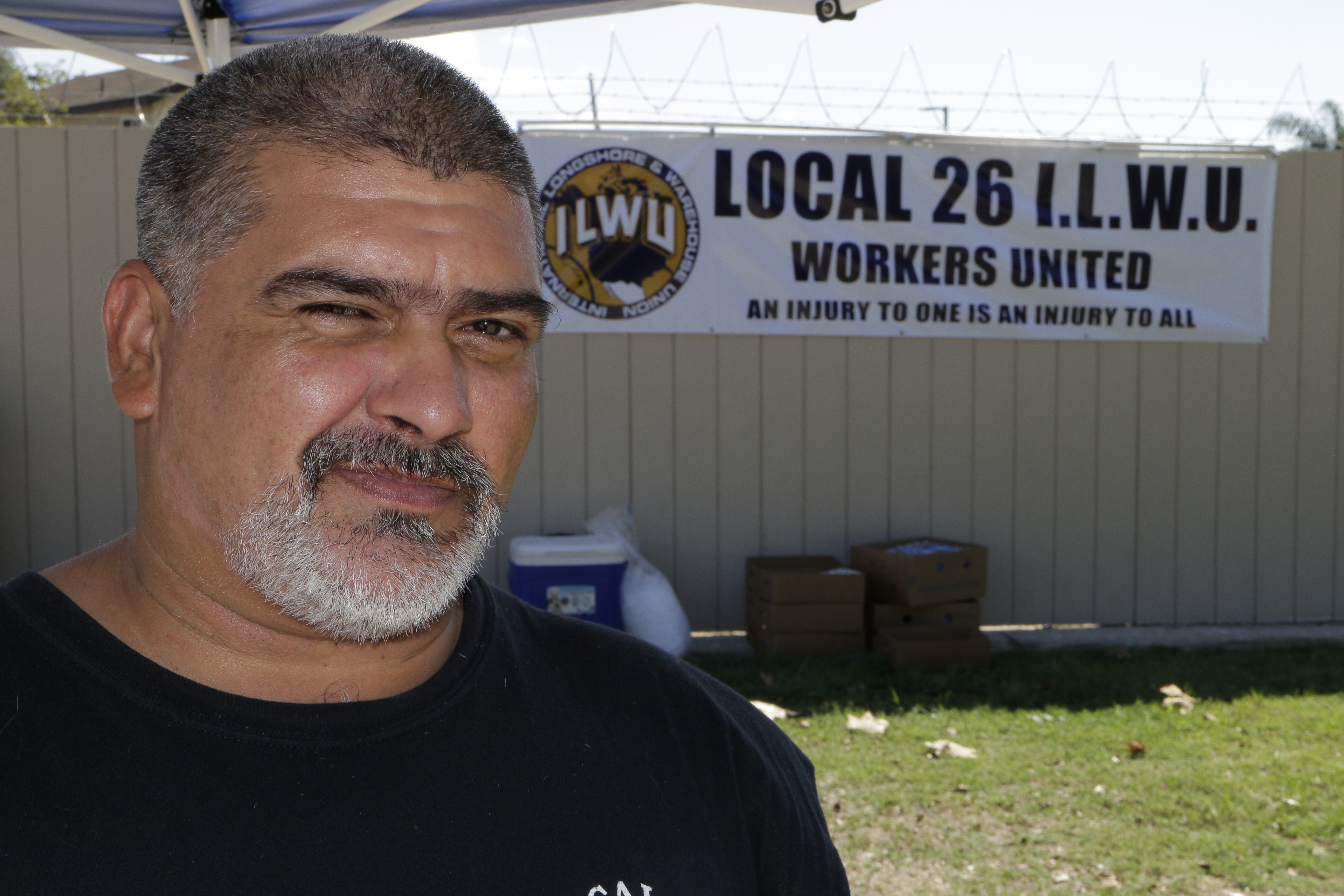
Local 26 member David Gonzales is leading an impressive but quiet effort with other volunteers in Wilmington who serve hundreds of meals each week to homeless and hungry people in the harbor area.
“I know what it’s like to be on the streets because I was there once myself,” says Gonzales, tracing his ordeal that began when he was physically and mentally abused almost daily by a stepfather “from the time I was 3 until I was 13.” When he was able to fight back, his mother said he’d have to leave the house, so he ended up in Banning Park. Gonzales tried to continue at school while he was living on the streets, but eventually dropped out and became involved with drugs and gangs.
“I can see now that the gang was important to me because I didn’t have a father, and it filled a need for a while,” he says. “Gang life gave me some security, but also filled my mind with distrust of anyone who wasn’t exactly like us. After years of “gangbanging” and coloring much of his skin with tattoos, he began to look for a way out of his dependency on drugs and the street life, but getting out was difficult. That’s where the union came in.
“I’m from a 4th generation Wilmington family here, so I knew how important the union was to the community, but I never realized that it would be the thing that helped me turn my life around.”
Gonzales found work as a guard with ILWU Local 26, providing security on the docks at the ports of LA and Long Beach. What he found was a surprising degree of support from co-workers who made a difference in his life.
“When my baby girl was just 9 months old, she had a life-threatening heart defect that required a dangerous surgery.” Gonzales said Local 26 union steward Mark Reyes offered to become her godfather, something “nobody had ever done for me and my family before.”
A similar act of kindness and compassion happened several years ago when he ended a difficult personal relationship and took full responsibility for his 7 children.
“It was holiday time and one of the union sisters at work, Christina Le Blanc who’s the Lead Sargent at Hanjin, asked me how I was planning to celebrate Christmas. I told her that it was going to be a little rough that year but that we’d be fine. She went out on her own and asked the other guards to pitch-in, and they made it possible for my kids to have something special during that difficult time.”
As the life of gang-banging and drug addiction was left behind, Gonzales says he now lives his life in recovery following a simple philosophy of what he calls “paying it forward.”
It started with an inspiration to buy boxes of frozen hamburger patties that he could grill for hungry people still stuck on the street. He quickly found others willing to help and says many of those volunteers were once living on the streets themselves during a difficult stretch. “We know what it’s like to be out there.”
Using Facebook, Gonzales has mustered a volunteer crew that prepares hundreds of sack lunches every Thursday, then distributes the meals to people living in the margins from Wilmington to LA’s Skid Row.
“We made 490 sack lunches last week and could have done a lot more but we just ran out of time,” he says, noting that groups and individuals are donating everything from bread and lunch meat, to their own labor. “We don’t have a formal non-profit group, but we do get the job done because everyone pitches-in to help the group that we call: ‘Heart of the Harbor/Helping Those in Need.’”
The group also helps with special needs or particular requests, such as one for diapers and wipes that was recently fulfilled with an online request to volunteers.
The biggest feeding effort so far took place on Saturday, October 3rd at Wilmington’s “Greenbelt Park,” between Watson and “L” Street. Volunteers began arriving at 7am to cook and prepare a hot lunch for hundreds from 12 noon onward. Among the many helpers were several of Gonzales’ seven children who are regular volunteers.
The first volunteer to join Gonzales was Nikki Fabela, Wilmington resident and daughter of Local 13’s Paul Fabel. “She was the first person who said she’d help me,” said Gonzales, “and her gesture of kindness is something I’ll never forget.”
“We know there are at least 8 people who have gotten off the streets and turned their lives around because of our help,” says Gonzales, who points to the turnaround in his own life as proof that dramatic changes are possible.
Gonzales says that their project is open to everyone and is not part of a church, but he says they do try to pause at some point during the busy volunteer times to give thanks and reflect on the pain and suffering faced by so many in the world – and how volunteers can make a difference with love and action.
Gonzales emphasizes that their group is eager to partner with individuals and like-minded organizations who can provide resources such as transitional housing, mental health services and recovery/rehabilitation support.
“My 17 years in the union have provided me with so much support that made my turnaround and recovery possible,” he says, adding that it has also expanded his perspectives, noting that he’s been able to meet people from all over the world and get beyond the small-minded thinking and bigotry that came with life in a gang. “I now see that all of us have so much in common, instead of focusing on difference like I used to, about how people looked or talked. I am truly grateful to all of my union brothers and sisters who have shown me so much solidarity and positivity during my years on the waterfront.”
Thursday, October 29, 2015
DECISION AND ORDER- DENYING IN PART AND GRANTING IN PART WAIVER OF OVERPAYMENT OF BENEFITS UNDER THE BLACK LUNG BENEFITS ACT
DECISION AND ORDER- DENYING IN PART AND GRANTING IN PART WAIVER OF OVERPAYMENT OF BENEFITS UNDER THE BLACK LUNG BENEFITS ACT
In the Matter of:
BILL H. RAMEY,
Claimant
v.
DIRECTOR, OFFICE OF WORKERS' COMPENSATION PROGRAMS,
Party-in-Interest
Appearances:
Andrew Delph, Esq. For the Claimant
Karen Barefield, Esq., For the Director

Before: RICHARD A. MORGAN Administrative Law Judge
This case arises from a claim for benefits under the “Black Lung Benefits Act,” Title IV of the Federal Coal Mine Health and Safety Act of 1969, as amended, 30 U.S.C. § 901, et seq. (“Act”), and applicable federal regulations, mainly 20 C.F.R. Parts 404 and 725. (“Regulations”).
Congress created a Black Lung Disability Trust Fund (“Trust Fund”) in order to provide claimants with interim benefit payments, i.e., where the operator liable for payments does not commence them within thirty days of the initial eligibility determination. 30 U.S.C. §§ 901-945; 9501(d). Here, the claimant was paid benefits, under the Act. Section 413(b) of the Act authorizes the Department of Labor to recover erroneous Trust Fund payments or “overpayments.” 30 U.S.C. § 923(b). The Director, Office of Workers’ Compensation Programs (“OWCP”)(“Director”) claims an overpayment was made because the claimant’s award of interim benefits was overturned on appeal. The claimant seeks waiver of the overpayment.
The claimant filed for black lung benefits on March 25, 2010. The District Director issued a Proposed Decision and Order awarding benefits on November 29, 2010. The employer objected to that finding and requested a formal hearing. The claimant was paid interim benefits by the Black Lung Disability Trust Fund. On July 12, 2012, an Administrative Law Judge issued a Decision and Order Denying Benefits. This denial of benefits was not appealed.
On October 10, 2012, the District Director notified the claimant of an overpayment in the amount of $26,021.44 which includes $12,050.56 in monthly benefits and $13, 970.88 in medical benefits. The District Director made a preliminary finding that the claimant was without fault. On December 7, 2012, the District Director denied waiver of overpayment, finding that the claimant had not shown either that recovery of the overpayment would defeat the purpose of the Act or that recovery would be against equity and good conscience. The claimant responded to the District Director’s initial determination by letter dated December 5, 2012, received by the U.S. Department of Labor on December 12, 2012, requesting a waiver of this overpayment, submitting an overpayment questionnaire and requesting an additional 90 days to submit receipts, bank statements and other supporting evidence pertaining to his request for a waiver of overpayment. By letter dated January 8, 2013. Claimant submitted financial information including bills, bank statements and other evidence.
On June 27, 2013, the District Director issued a “final determination” finding that the overpayment is now considered a debt due and owing to the Federal government which must be repaid. By letter dated July 3, 2013, the claimant, through his attorney requested a formal hearing and the case was referred to the Office of Administrative Law Judges. I was assigned the case on August 27, 2013. I conducted a formal hearing on August 20, 2015 in Charleston, West Virginia. Director’s Exhibits (“DX”) 1-12 and Claimant’s Exhibit (“CX”) 1 were admitted with no objections.
.....SEE ARTICLE FOR DETAILS
It is ordered that the claim for waiver of recovery of an overpayment in the amount of $26,021.44 is denied in part, and granted in part. Waiver of recovery is hereby DENIED in regard to the $12,050.56 in monthly benefits paid to the claimant. Waiver of the overpayment of $13,970.88 in medical benefits is hereby GRANTED, as recovery would be “against equity and good conscience.” The claimant must reimburse the Black Lung Trust Fund for the adjusted overpayment, in the amount of $12,050.56.
In the Matter of:
BILL H. RAMEY,
Claimant
v.
DIRECTOR, OFFICE OF WORKERS' COMPENSATION PROGRAMS,
Party-in-Interest
Appearances:
Andrew Delph, Esq. For the Claimant
Karen Barefield, Esq., For the Director

Before: RICHARD A. MORGAN Administrative Law Judge
This case arises from a claim for benefits under the “Black Lung Benefits Act,” Title IV of the Federal Coal Mine Health and Safety Act of 1969, as amended, 30 U.S.C. § 901, et seq. (“Act”), and applicable federal regulations, mainly 20 C.F.R. Parts 404 and 725. (“Regulations”).
Congress created a Black Lung Disability Trust Fund (“Trust Fund”) in order to provide claimants with interim benefit payments, i.e., where the operator liable for payments does not commence them within thirty days of the initial eligibility determination. 30 U.S.C. §§ 901-945; 9501(d). Here, the claimant was paid benefits, under the Act. Section 413(b) of the Act authorizes the Department of Labor to recover erroneous Trust Fund payments or “overpayments.” 30 U.S.C. § 923(b). The Director, Office of Workers’ Compensation Programs (“OWCP”)(“Director”) claims an overpayment was made because the claimant’s award of interim benefits was overturned on appeal. The claimant seeks waiver of the overpayment.
The claimant filed for black lung benefits on March 25, 2010. The District Director issued a Proposed Decision and Order awarding benefits on November 29, 2010. The employer objected to that finding and requested a formal hearing. The claimant was paid interim benefits by the Black Lung Disability Trust Fund. On July 12, 2012, an Administrative Law Judge issued a Decision and Order Denying Benefits. This denial of benefits was not appealed.
On October 10, 2012, the District Director notified the claimant of an overpayment in the amount of $26,021.44 which includes $12,050.56 in monthly benefits and $13, 970.88 in medical benefits. The District Director made a preliminary finding that the claimant was without fault. On December 7, 2012, the District Director denied waiver of overpayment, finding that the claimant had not shown either that recovery of the overpayment would defeat the purpose of the Act or that recovery would be against equity and good conscience. The claimant responded to the District Director’s initial determination by letter dated December 5, 2012, received by the U.S. Department of Labor on December 12, 2012, requesting a waiver of this overpayment, submitting an overpayment questionnaire and requesting an additional 90 days to submit receipts, bank statements and other supporting evidence pertaining to his request for a waiver of overpayment. By letter dated January 8, 2013. Claimant submitted financial information including bills, bank statements and other evidence.
On June 27, 2013, the District Director issued a “final determination” finding that the overpayment is now considered a debt due and owing to the Federal government which must be repaid. By letter dated July 3, 2013, the claimant, through his attorney requested a formal hearing and the case was referred to the Office of Administrative Law Judges. I was assigned the case on August 27, 2013. I conducted a formal hearing on August 20, 2015 in Charleston, West Virginia. Director’s Exhibits (“DX”) 1-12 and Claimant’s Exhibit (“CX”) 1 were admitted with no objections.
.....SEE ARTICLE FOR DETAILS
ORDER
It is ordered that the claim for waiver of recovery of an overpayment in the amount of $26,021.44 is denied in part, and granted in part. Waiver of recovery is hereby DENIED in regard to the $12,050.56 in monthly benefits paid to the claimant. Waiver of the overpayment of $13,970.88 in medical benefits is hereby GRANTED, as recovery would be “against equity and good conscience.” The claimant must reimburse the Black Lung Trust Fund for the adjusted overpayment, in the amount of $12,050.56.
APL SETTLES ON ALLEGED US FALSE CLAIMS ACT VIOLATIONS
APL SETTLES ON ALLEGED US FALSE CLAIMS ACT VIOLATIONS

Arizona-based ocean carrier APL Limited has agreed to pay the U.S. government USD 9.8 million to resolve allegations that it violated the False Claims Act in connection with a contract to provide GPS tracking of shipping containers in Afghanistan, the U.S. Justice Department said.
The U.S. Department of Defense contract required APL, a wholly-owned American subsidiary of Singapore-based Neptune Orient Lines Limited, to affix a satellite tracking device to each shipping container transported from Karachi, Pakistan, to U.S. military bases in Afghanistan, when the Department of Defense (DOD) requested the tracking services.
The United States alleges that APL billed the DOD for tracking services despite knowing that the tracking devices completely or partially failed to transmit data, or were not affixed to shipping containers.
The U.S. government also claims that APL attached a single satellite tracking device to two shipping containers despite being required to affix one device to every container.
“Today’s settlement demonstrates our commitment to ensure that contractors doing business with the military perform their contracts honestly,” said Principal Assistant Attorney General Benjamin C. Mizer, head of the Justice Department’s Civil Division.
The claims resolved by this civil settlement are allegations only and there has been no determination of liability, the U.S. Justice department said.
Tuesday, October 27, 2015
PAVILLION ENERGY AND GAZPROM SIGN 10-YEAR LNG SUPPLY DEAL
PAVILLION ENERGY AND GAZPROM SIGN 10-YEAR LNG SUPPLY DEAL
Singapore-based Pavillion Energy has signed a 10-year Sales & Purchase Agreement for liquefied natural gas (LNG) with a subsidiary of Russia’s gas major Gazprom, Seah Moon Ming, the company’s chief executive officer, said today in his keynote address at Gastech Singapore 2015.

First deliveries within the new agreement are expected two to three years from now Seah said, without disclosing the volume of LNG to be delivered, or the value of the contract.
This Temasek portfolio company has also signed a Memorandum of Understanding (MOU) with China Huadian Green Energy to supply cargoes of LNG to the company from 2020 onward, as well as an MOU with Japan’s JERA for collaboration in joint LNG procurement and investment, Seah said in his speech.
”Pavilion Energy is currently focused on developing regional demand. We see this as an important step towards building a reliable and robust LNG ecosystem in Singapore, and hopefully for Asia,” Seah said.
Seah also said that the company sees Singapore as well-equipped to host this new and more open way of doing business in the LNG sector.
”The International Energy Agency or IEA has expressed confidence about Singapore’s prospects, and believes Singapore will eventually emerge as Asia’s premier LNG Trading Hub,” Seah said.
Thursday, October 22, 2015
A MINER'S CLAIM FOR BENEFITS UNDER THE BLACK LUNG BENEFITS ACT
A MINER'S CLAIM FOR BENEFITS UNDER THE BLACK LUNG BENEFITS ACT
.....CLICK LINK FOR FULL ARTICLE
In the Matter of:
DARRYL L. RUTROUGH,
Claimant,
v.
OMEGA MINING, INC/
NATIONAL UNION FIRE/CHARTIS,
Employer/Carrier,
and
DIRECTOR, OFFICE OF WORKERS’ COMPENSATION PROGRAMS,
Party-in-Interest.
Case No.: 2012-BLA-05710
Procedural History
Claimant filed his claim for benefits on November 2, 2010. (Director’s Exhibit (“DX”)
2). The claim was denied by the district director on February 12, 2012, because, although the
evidence established the presence of pneumoconiosis which arose out of Claimant’s coal mine
employment, the evidence failed to establish that Claimant was totally disabled due to
pneumoconiosis. (DX 32). On March 5, 2012, Claimant requested a hearing before an
administrative law judge. On April 16, 2012, the case was referred to the Office of
Administrative Law Judges by the Director, Office of Workers’ Compensation Programs
(OWCP) for a formal hearing. (DX 35).
On January 14, 2015, I held a hearing in Abingdon, Virginia, at which Claimant was
represented by a lay representative and employer and insurer were represented by counsel. The
Solicitor entered a written appearance for the Director, Office of Workers’ Compensation
Programs (“OWCP”), but did not attend the hearing. The parties were afforded the full
opportunity to present evidence and argument. Claimant’s exhibits (“CX”) 1-9, Director’s
exhibits (“DX”) 1-37, and Employer’s exhibits (“EX”) 1-8 were admitted into the record
(Hearing Transcript (“TR”) 6, 9). In addition, Employer was allowed time post-hearing to submit
a rebuttal x-ray reading, an affirmative pulmonary function study and updated reports by Drs.
Rosenberg and Dahhan (TR 9). Post-hearing evidence consists of a pulmonary function study by
Dr. David M. Rosenberg performed on February 3, 2015 (EX 4), an updated report by Dr.
Rosenberg dated April 14, 2015, (EX 6) and an updated medical report by Dr. A. Dahhan dated
March 20, 2015 (EX 7).
Issues
At the hearing, Employer stipulated that Claimant worked as a miner for 22.38 years. At
the hearing, Employer stated the issues remaining included: 1) Whether Claimant has
pneumoconiosis as defined by the Act and the Regulations; 2) Whether Claimant’s
pneumoconiosis arose out of his coal mine employment; 3) Whether Claimant is totally disabled;
and 4) Whether Claimant’s disability is due to pneumoconiosis (TR 10).
In the closing brief, however, Employer conceded that the evidence is sufficient to
establish that Claimant has pneumoconiosis, that his pneumoconiosis arose out of coal mine
employment, that Claimant is totally disabled and that his disability is due to pneumoconiosis.
Employer contends that the only remaining issue is the onset date when benefits may
commence.

Conclusions
In conclusion, Claimant has established that he has pneumoconiosis that arose out of his
coal mine employment, as defined by the Act and Regulations. Claimant has established that he
is totally disabled due to pneumoconiosis. The evidence establishes an onset date of March,
2013.
ILWU MEMBERS TELL OAKLAND CITY COUNCIL TO KILL COAL TERMINAL PLAN
ILWU MEMBERS TELL OAKLAND CITY COUNCIL TO KILL COAL TERMINAL PLAN
An overflow crowd at the Oakland City Council meeting on September 15 heard ILWU leaders taking passionate positions against a controversial coal export terminal that developers and coal industry lobbyists want to build on a private dock with public subsidies. Six hundred citizens submitted requests to speak at the hearing which began at 4pm and went late into the night.
Developer hiding
Master developer Phil Tagami was noticeably absent from the public hearing on the coal export terminal which has become a centerpiece of his redevelopment scheme that promised to transform Oakland’s former Oakland Army base into a mix of modern warehouses, intermodal hub and a “state of the art” privately-owned break-bulk dock.
Jobs Promised
To win crucial political support, Tagami claimed his project would create thousands of good-paying jobs, and told community and labor groups that most of those jobs would be union. But many of the groups negotiating with Tagami were unfamiliar with industry employment practices, which may have allowed the developer to use inflated and unrealistic numbers. Now Tagami has hitched his project’s to a controversial coal export terminal, and suggested that the entire project and thousands of jobs depend on the coal deal.
Coal lobbyists & lawyers
Instead of appearing in person at the September hearing, Tagami hired a slew of well-dressed lawyers, lobbyists, businessmen and preachers to make his case for the coal terminal. Lawyers made thinly-veiled threats that lawsuits would be filed if the developers didn’t get their way. One Washington D.C. lawyer declared that the city had no authority to regulate or limit railroads shipping coal to the export terminal.
Buying turnout
But despite hiring big guns, Tagami’s team had a hard time finding actual “concerned citizens” who supported the coal terminal, so they resorted to paying people to fill seats and wear t-shirts. The plan backfired when news reporters interviewed apparent “coal supporters” in the audience who quickly admitted they only came because they were paid. Some even expressed confusion about which side they were supposed to support.
Buying loyalty
The pay-to-play tactics included generous “offers” from the coal lobbyists to local churches and environmental groups – in exchange for backing the coal terminal. A team of former executives from the Port of Oakland reportedly offered church leaders 7 cents for every ton of coal that would be exported; environmental groups were offered a more generous 12 cents per ton. The environmental groups declined the offer; while some church leaders apparently accepted and attended the hearing to praise the proposal.
Labor unity & exceptions
The Alameda County Central Labor Council told City officials that unions had just passed a strong resolution opposing the coal export terminal, because it would provide few jobs, threaten nearby residents and harm efforts to control climate change. Two unions, the Teamsters and Laborers, tried but failed to stop the labor body from adopting the coal terminal resolution.
Both were told by the developer that the good union jobs being promised could not be delivered without the coal terminal. Teamster officials joined developer Phil Tagami in avoiding the public hearing, but lobbied for the coal project behind the scenes.
Broken promises
Developer Phil Tagami was singing a different tune several years ago when he was desperate to secure political support from labor unions, community and environmental groups for his development plan. He promised groups that coal would not be part of his project, then used their support to win approval from the Oakland City Council and $400-500 million in public subsidies. After winning political approval, it was revealed that developers were working closely with anti-union coal companies in Utah who desperately want a private dock to export their fuel abroad, and offered developers $53 million to make it happen.
Exporting coal abroad
Exports are crucial to North America’s coal industry because domestic consumption and prices are falling as the dirty fuel is replaced with cleaner and cheaper natural gas and alternatives such as solar. This reality has forced the coal industry – now almost entirely non-union – to sell their product abroad to countries with minimal environmental and worker safety protections, such as China, Vietnam, and India. These countries have historically resisted global agreements to limit greenhouse gas emissions that cause global climate change. China recently declared a willingness to adopt a market- based “cap-and-trade” system like America’s, which allows companies to “buy” their right to pollute.
Explaining ILWU views
The ILWU approached the coal hearing with a unified voice. Local 10, Local 34 and the Northern California District Council have all taken positions opposing the coal terminal. Local= 10 Business Agent Derrick Muhammad was the first ILWU member to speak at the public hearing on September 15. Muhammad immediately assailed the simplistic job arguments used by coal terminal supporters.
“Prostitution and drug dealing both create lots of jobs in Oakland, but they aren’t the kind of jobs we need,” said Muhammad, who declared that coal terminal jobs should be similarly unwelcome.
Chris Christensen, President of the Bay Area Longshoremen’s Memorial Association, also testified about the downside of coal jobs for the community and longshore workers and urged the City Council to oppose the coal export terminal.
Local 6 Secretary-Treasurer Fred Pecker represented the ILWU’s Northern California District Council, arguing that West Oakland residents have long suffered from heavy pollution in their neighborhood, and deserve better options than a coal terminal.
Expert testimony
A team of experts, including several current and former government officials, testified about the dangers of transporting and burning coal. They included the State of California’s former top environmental health official, a current EPA official and Alameda County’s public health officer.
The health officials joined engineering experts who said the coal terminal involved unnecessary health, environmental and economic risks. One expert noted that a similar expensive coal terminal investment by the Port of Los Angeles had failed to generate the jobs and business that were promised] by the coal industry.
Company threats
In addition to threatening lawsuits at the public hearing, coal interests have been quietly investigating several Oakland City Council members who expressed concern about the coal terminal.
A Denver-based law firm that represents the nation’s largest coal companies and Wall Street firms who finance them, is seeking emails, voice mails, texting and other communication records from Council members.
Media coverage
Media coverage of the September City Council hearing on the coal terminal was extensive, and some outlets have devoted resources to investigating the project in greater detail. Investigative reporter Darwin BondGraham of the East Bay Express has led the way by exposing the coal industry’s financial and lobbying networks that usually operate in the shadows.
“The bottom line,” says Local 10 President Melvin Mackay, “is that this coal terminal is not something members support because it’s bad for the community, bad for the union and bad for the environment.”
ILWU AND COMMUNITY COALITION CHALLENGE DANGEROUS CRUDE OIL TERMINAL IN VANCOUVER, WA
ILWU AND COMMUNITY COALITION CHALLENGE DANGEROUS CRUDE OIL TERMINAL IN VANCOUVER, WA
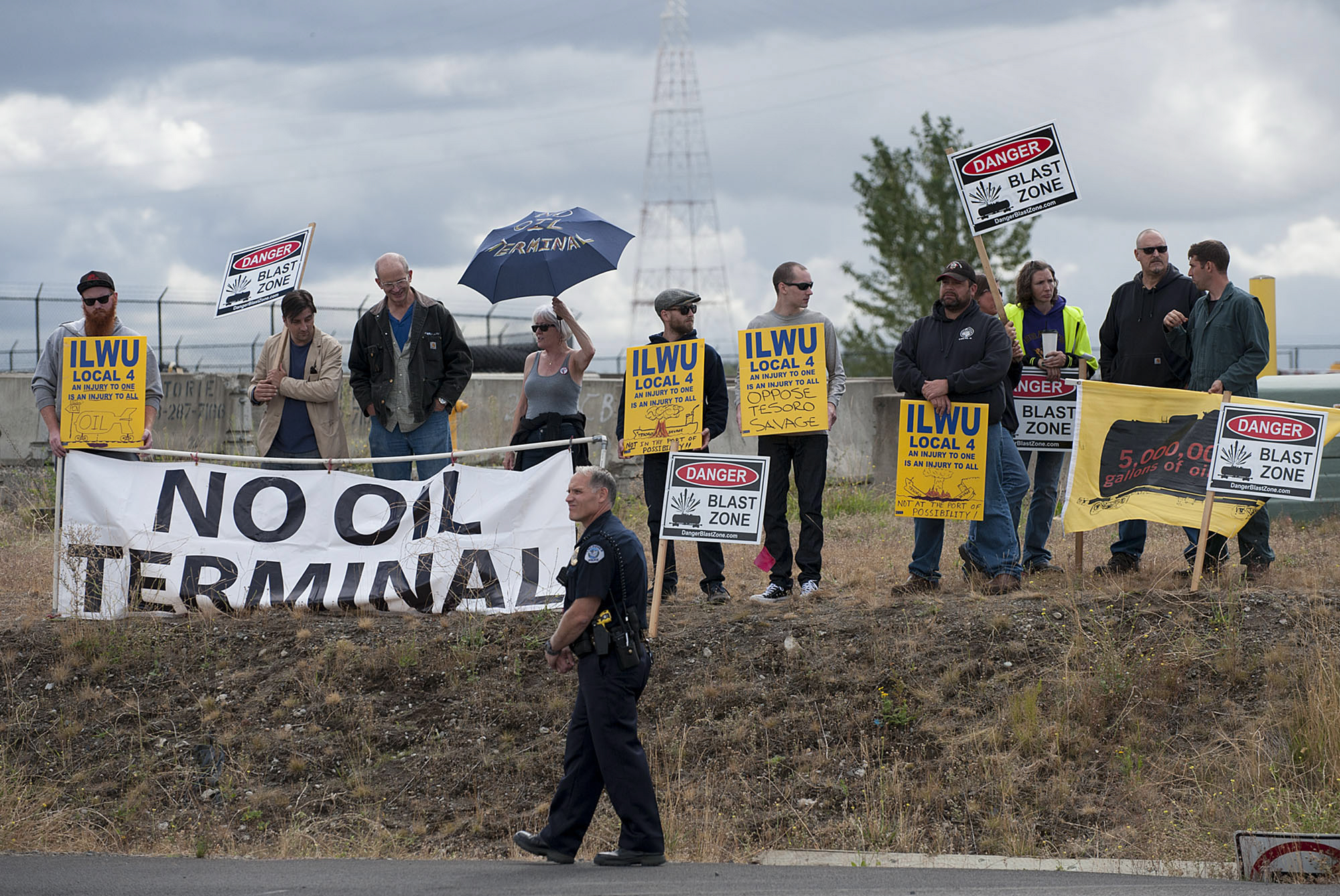
Members of ILWU Local 4 have joined forces with community and environmental allies to stop a scheme by big oil that could ruin their port, close the Columbia River and turn their city into a disaster area.
Power play
Documents show that officials from the Port of Vancouver reached a deal in secret with oil companies to build the nation’s largest oil-to-marine export terminal without first holding public hearings on the controversial and dangerous proposal.
Four trains a day
Big oil wants to bring four “unit trains” a day to the Port of Vancouver. Each of the mile-long trains would carry 100 or more tank cars filled with highly volatile and explosive crude from the Bakken oil fields of North Dakota. Each of the cars carry 30,000 gallons of highly flammable crude as the trains travel through dozens of towns before reaching the west coast.
Possible disaster
The possibility of a catastrophic disaster that could wipeout parts of Vancouver and other town became more real on July 6, 2013. That’s when a train carrying Bakken crude oil derailed and exploded in a cataclysmic firestorm that destroyed much of Lac-Megantic, a town in Quebec, Canada. The disaster killed 47 residents and injured many others.
“Bringing this stuff into our town is just irresponsible and too dangerous,” says Local 4’s Cager Clabaugh who has told Port Commissioners that “the risk isn’t worth the reward.”
He notes that Local 4 members opposed plans for an oil export terminal in their town before the 2013 disaster in Quebec, and have strengthened their resolve since.
“Before that disaster, oil industry lobbyists were assuring our Port Commissioners that this stuff was safe and there was nothing to worry about,” said Clabaugh. “They changed their tune after the Lac-Megantic disaster, but are still saying it’s safe enough and refuse to drop their dangerous plan.”
.....CLICK LINK FOR FULL ARTICLE
Tuesday, October 20, 2015
EIB SETS ASIDE EUR 165 MILLION FOR AMSTERDAM SEA LOCK
EIB SETS ASIDE EUR 165 MILLION FOR AMSTERDAM SEA LOCK
The European Investment Bank (EIB) has agreed to provide EUR 165 million (187.5m) to support the construction of a new sea lock at IJmuiden, the principal access to the Dutch Port of Amsterdam.
The current Noordersluis lock was built in 1929 and the new larger lock will ensure that the next generation of bulk carriers, container ships and cruise ships can continue to access the Port of Amsterdam and the North Sea Canal, and is expected to reduce waiting time for ships.
The new sea lock will be 500 meters long, 70 meters wide and 18 meters deep, and able to operate in all tides. The IJmuiden sea lock is expected to support economic activity both along the North Sea canal and for companies using the Port of Amsterdam, Europe’s fourth busiest port.
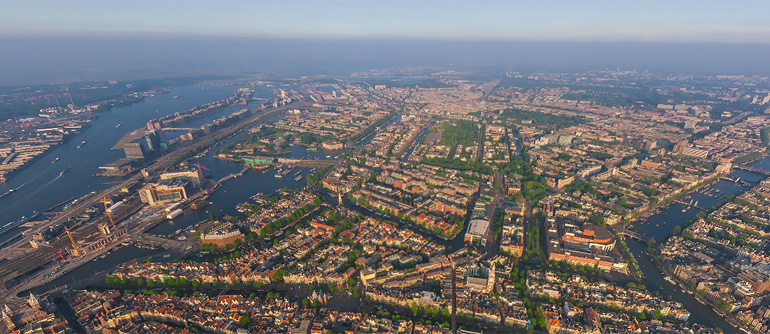
Europe’s long-term investment institution will provide 33% of the debt financing for the project, alongside a consortium of banks including Sumitomo Mitsui Banking Corporation, The Bank of Tokyo-Mitsubishi UFJ, UniCredit Bank, DZ BANK and KfW IPEX-Bank, whereas Rabobank is providing an equity bridge facility.
The lock is procured as a public private partnership of the Dutch Ministry of Infrastructure and Environment through Rijkswaterstaat, and is supported by the province of North Holland and the municipality of Amsterdam.
“90% of Europe’s international trade passes through ports and upgrading the IJmuiden sea lock complex is crucial to ensuring the Port of Amsterdam’s leading role. Amsterdam has more distribution centres than any other region in Europe and the port supports companies dependent on logistics across the Netherlands and northern Europe,” said Pim van Ballekom, European Investment Bank Vice President.
Subscribe to:
Posts (Atom)